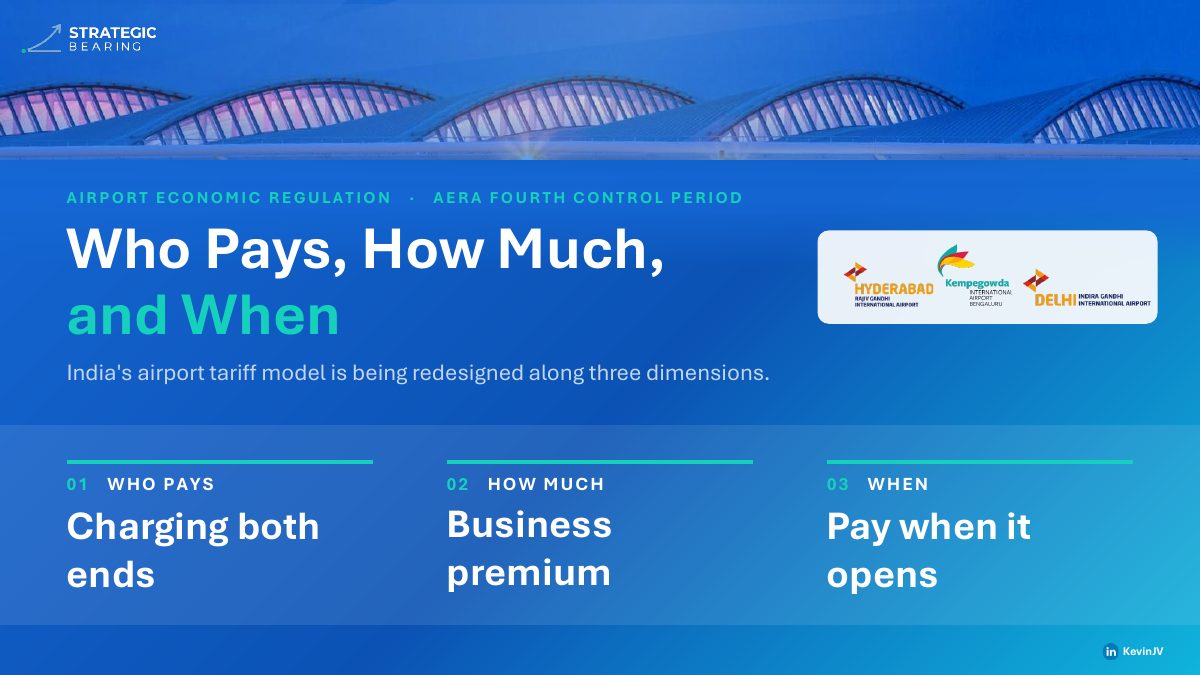
Who Pays. How Much. When. India’s Airport Tariff Model Is Evolving.
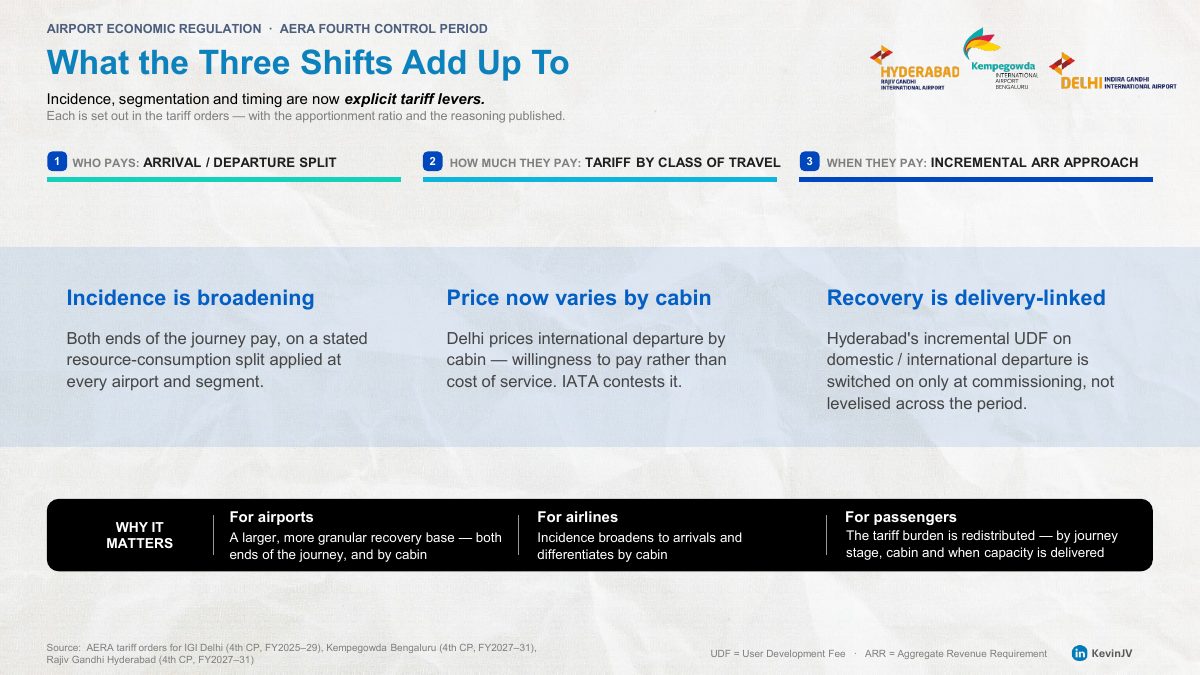
Three recent AERA decisions at Delhi, Bengaluru and Hyderabad point to three distinct shifts in tariff design: Incidence - who pays; segmentation - how much they pay; and timing - when recovery happens.
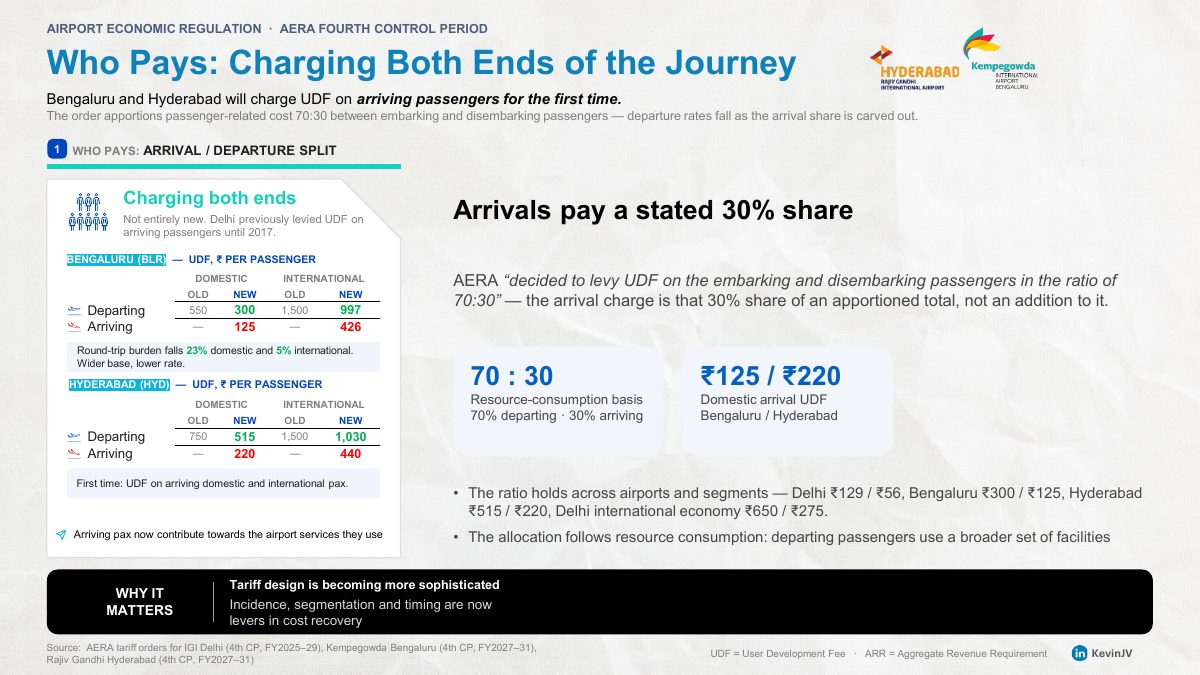
1. Incidence is broadening.
Bengaluru and Hyderabad are bringing arriving passengers into the UDF base. But the principle is not new. Delhi previously levied UDF on arriving passengers until 2017, while AERA has since approved arrival UDF at Mangaluru and Goa Mopa.
AERA apportions passenger-related costs 70:30 between embarking and disembarking passengers, reflecting its assessment of the relative use of passenger-related facilities.
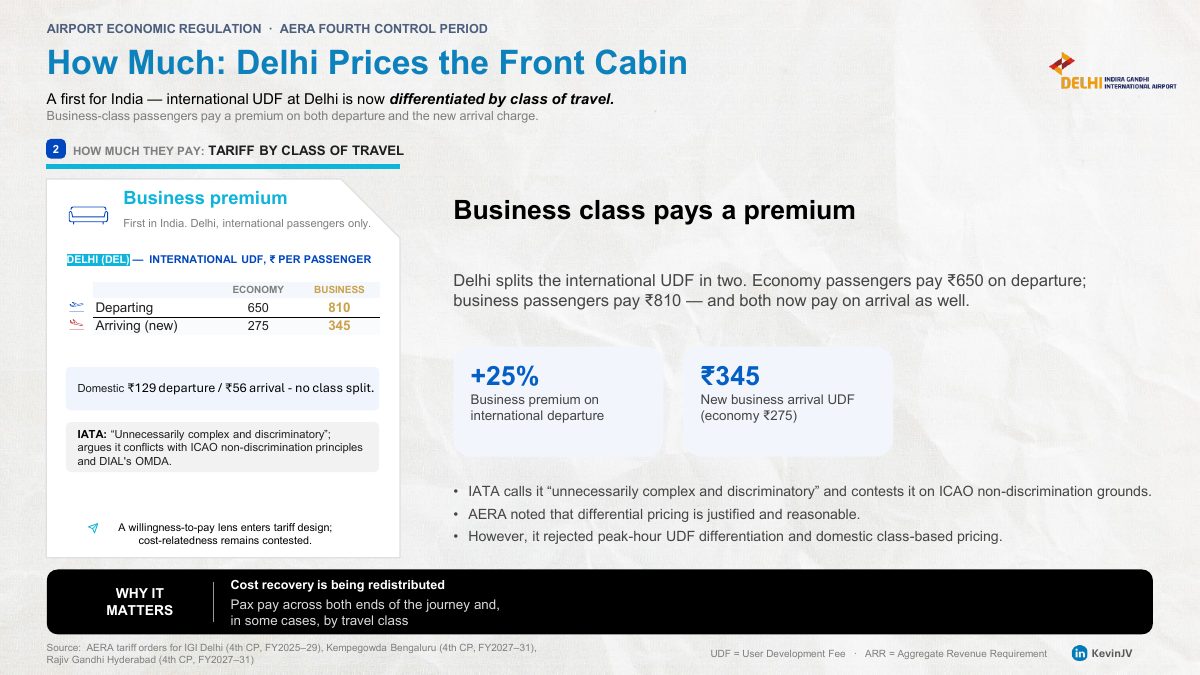
2. Passenger segmentation is entering airport pricing.
Delhi’s differentiation of international UDF between economy and business class is perhaps the more interesting tariff experiment.
AERA’s justification is service differentiation: Business Class passengers may receive additional facilities such as dedicated check-in, security clearance, immigration and boarding arrangements. The Authority therefore considers a higher UDF reasonable, while noting similar differential pricing at Hong Kong.
But the decision also introduces a broader question for airport economics:
When passenger classes receive differentiated service, should airport charges differentiate with them?
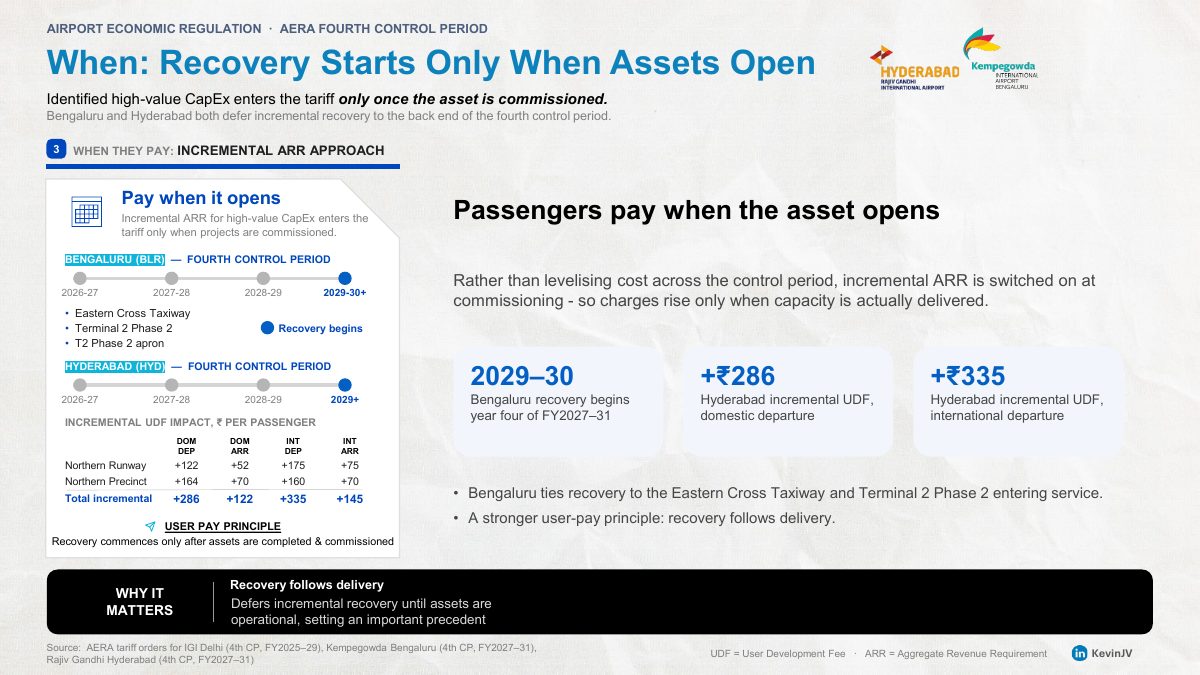
3. The most consequential change may be the timing of recovery.
Bengaluru’s Fourth Control Period introduces an Incremental ARR approach for identified high-value CapEx. Recovery for projects such as the Eastern Cross Taxiway and Terminal 2 Phase 2 enters the tariff when the assets are completed, commissioned and put into operational use, rather than forming part of the base tariff from the outset.
The same underlying logic applies at Hyderabad, with incremental UDF associated with the Northern Runway and Northern Precinct entering from 2029 following commissioning.
AERA’s rationale is interesting and, in the context of India, I think a step in the right direction:
→ Align recovery with actual availability of infrastructure.
→ Protect users from paying prematurely for assets not yet available.
→ Strengthen incentives for timely project execution and commissioning.
→ Reduce the risk of over-recovery from delays, deferments or non-execution.
→ Preserve the operator’s right to recover incurred investment and earn a reasonable return once the asset is in service.
The innovation isn't the elimination of true-up. It is moving the protection from an ex-post correction to an ex-ante linkage between project delivery and tariff recovery.
For regulators building or refining airport economic frameworks, this third lever is the one worth studying. It creates a closer alignment between capital deployment, project delivery, asset availability and tariff recovery, without denying the operator reasonable returns.
#airportariff
First published on LinkedIn, see the original.All writing →