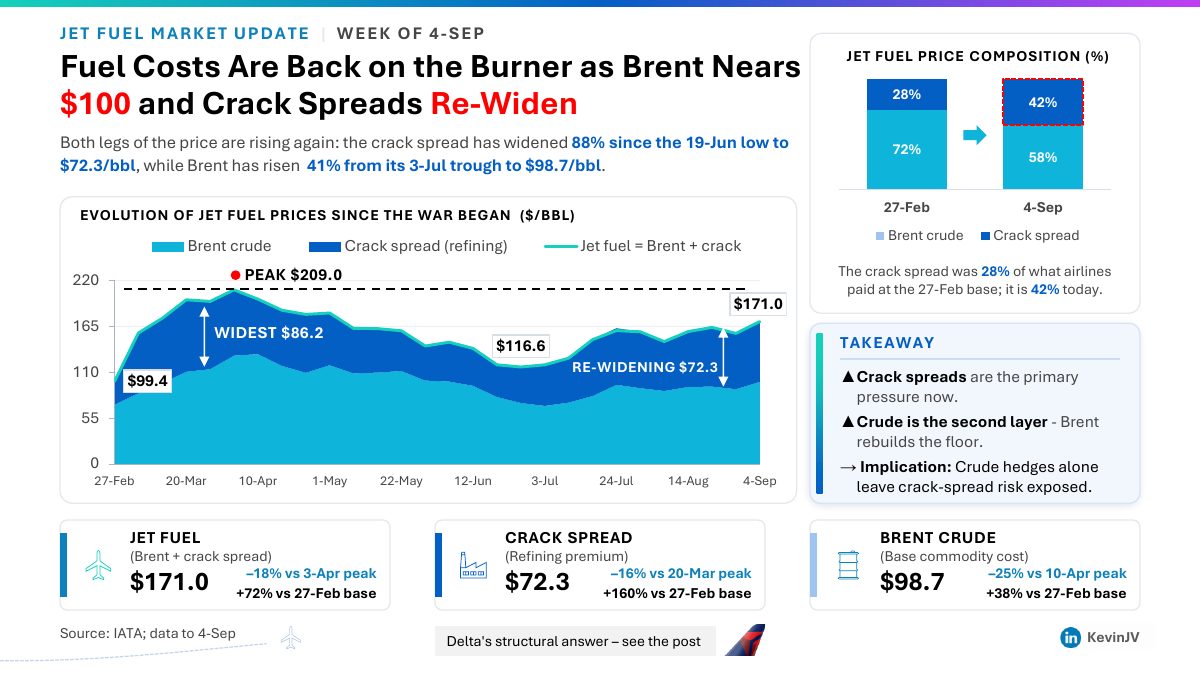
The crack spread has gone from a quarter of the jet fuel price to nearly half
The crack spread has gone from a quarter of the jet fuel price to nearly half. Should airlines explore strategic exposure to refining capacity?
Jet fuel is back above $170/bbl.
At the 27-February base, the crack spread was roughly 28% of what airlines paid. It is now 42%. Crude is up 38% since then. The spread is up 160%.
Both legs are rising again, Brent up 41% from its 3-July trough to $98.7/bbl; the crack up 88% from its 19-June low to $72.3/bbl.
For anyone hedging predominantly on Brent, that shift moves a growing share of the exposure outside the hedge. The basis risk isn't new. But its size is.
Delta took a structural approach in 2012, acquiring the Trainer refinery in Pennsylvania and running it alongside financial hedges and product-exchange agreements. At the time, Delta said the strategy could cover around 80% of its US jet-fuel needs.
Most carriers manage it through some combination of Brent, gasoil, jet-fuel swaps and crack instruments. IAG discloses derivatives referenced to Brent, gasoil, jet fuel, and both gasoil-Brent and jet-fuel-Brent cracks.
Do hedge ratios calibrated when refining was a quarter of the fuel price still hold when the crack is approaching half?
#Aviation #Airlines #FuelHedging #AirlineEconomics #CrackSpread #Brent #ATF
First published on LinkedIn, see the original.All writing →