Saudi carriers supplied just 10% of Dammam’s international seat capacity in 2025
Saudi carriers supplied just 10% of Dammam’s international seat capacity in 2025. That is the gap the Kingdom’s newest airline is launching into.
King Fahd International had ~17 million seats scheduled in 2025, almost evenly split between domestic and international.
The four largest international operators at Dammam were Air India Express, Emirates, IndiGo and Qatar Airways. flynas, the largest operator at the airport, was fifth.
Gulf hub carriers alone, Emirates, Qatar, Etihad, flydubai, Gulf Air and others accounted for ~40% of Dammam’s international seats. Indian carriers accounted for another 20%.
Much of that reflects Eastern Province demand being served through someone else’s network. Some demand does not reach Dammam at all: Bahrain sits close enough for part of this catchment to cross the causeway instead.
Dammam has the demand. What it has lacked is Saudi capacity on international routes.
Route economics is part of the explanation. But a genuine low-cost operator like Air Arabia, with a different cost base and network model, is well suited to addressing this gap.
Which is what makes today’s launch different from another entrant in a fairly crowded market.
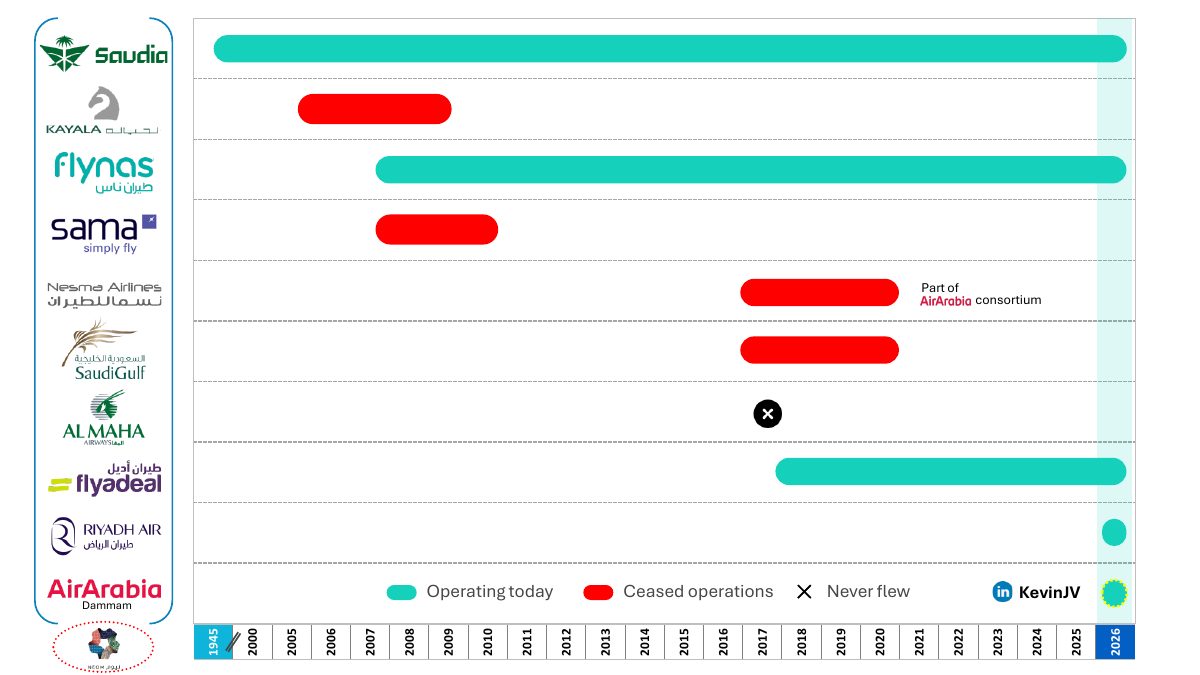
Saudi aviation now has five distinct platforms:
SAUDI AIRLINES as the established flag carrier.
Riyadh Air | طيران الرياض as a second national carrier built around Riyadh with global network ambitions.
flynas as a large independent LCC.
flyadeal as a Saudia Group LCC.
And now a Dammam-based LCC.
The question now is how these models complement each other across hubs, networks and infrastructure, and whether each is positioned where the gap actually sits.
Congrats to Air Arabia Dammam as it commences operations!
(This write-up is for educational/informational purposes only; happy to amend inaccuracies, if any)
#Airarabia #Dammam #KFIA #SaudiaAviation #Airarabiadammam
First published on LinkedIn, see the original.All writing →