Saudi Arabia’s Rail Boom & A New Mobility Equation for the GCC
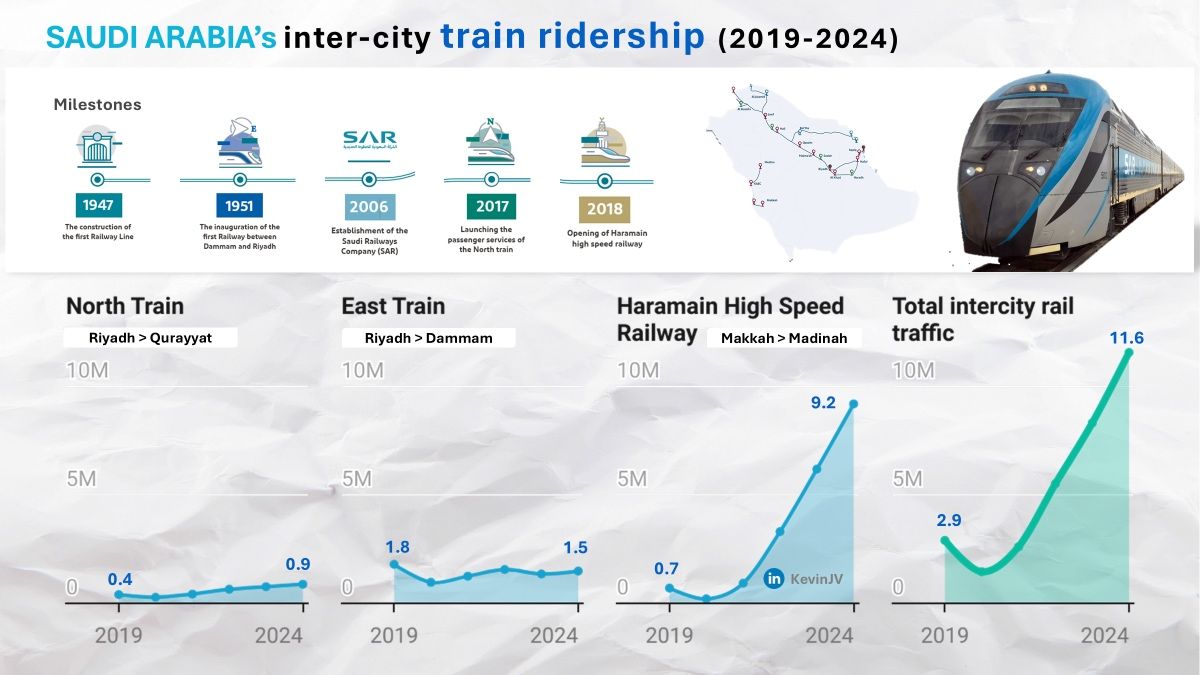
Between 2019 and 2024, despite COVID disruptions, intercity train ridership in the Kingdom grew 4×, reaching 11.6 million passengers, driven primarily by the Haramain High-Speed line.
Ridership Growth (2019 → 2024)
>North Train (Riyadh–Qurayyat): 0.4 M → 0.9 M (+0.5 M, CAGR ≈ 18.2 %)
>East Train (Riyadh–Dammam): 1.8 M → 1.5 M (–0.3 M, CAGR ≈ –3.7 %)
>Haramain (Makkah–Madinah): 0.7 M → 9.2 M (+8.5 M, CAGR ≈ 66.5 %)
Total intercity ridership: 2.9 M → 11.6 M (+8.7 M, CAGR ≈ 31.9 %)
> Haramain has become the flagship corridor, handling ~80 % of all intercity rail traffic.
> Traffic on the North line is inching up
> Decline in ridership on the East line deserves a careful close look. Air traffic data doesn’t show a sharp rise, suggesting some demand may be slipping to road.
The $250 Billion | 2,117-kilometre | cross-border GCC Rail
The six GCC member states are advancing a 2,000 KM+ cross-border railway slated for completion by December 2030. It will connect major ports, industrial zones, and cities from Kuwait to Oman, transforming how both people and goods move across the region.
If Saudi Arabia’s intercity rail performance is any indicator, the impact of GCC Rail on regional air travel would be massive, especially on sub-800 KM city pairs.
(This write-up is for educational/informational purposes only; happy to amend inaccuracies, if any. Views are personal.)
#GCCrailway
#SAR
#Saudiarabianrailway
First published on LinkedIn, see the original.All writing →