Global commercial aircraft delivery stats and demand outlook
✈ Global commercial aircraft delivery stats and demand outlook - a precursor to KSA's Fleet Overview as the series "Aviation in Saudi – Past, Present & Future" resumes.
Supply chain disruptions, workforce shortages and safety issues have led to production delays at major OEMs, causing significant ripple effects across the aviation industry. Production rates began to dwindle with the grounding of the 737 MAX in 2019 and were further exacerbated by the pandemic, which severely choked global supply chains.
Historical and Current Delivery Rates:
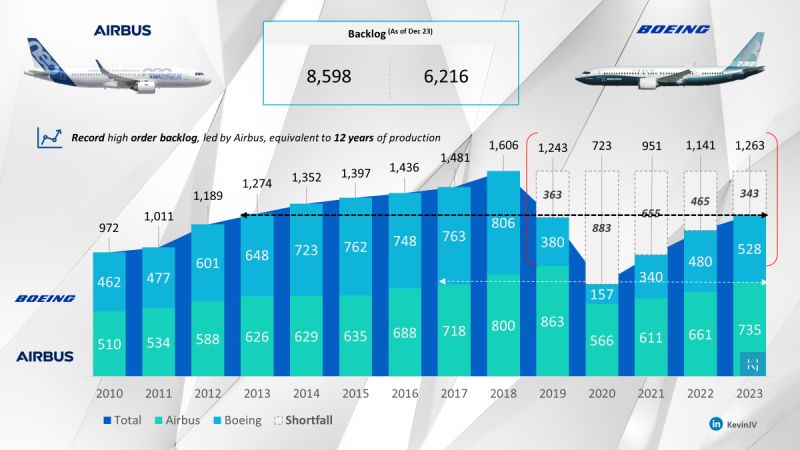
Using 2018 as the baseline, this analysis focuses on the two main OEMs: Boeing and Airbus. In 2023, total aircraft deliveries amounted to 1,263, representing a 21.4% decline compared to 2018 (equivalent to 2013 levels). Airbus deliveries were down 8.1%, while Boeing's deliveries dropped by about 35%.
In 2023, Airbus's delivery rates matched 2017 levels, while Boeing's deliveries fell to 2011-2012 levels, highlighting the depth of the challenges faced by the American manufacturer.
Backlog Analysis:
As of December 2023, the total backlogs amounted to:
▪ Airbus: 8,598 aircraft
▪ Boeing: 6,216 aircraft
At the current rates, it would take about 12 years to clear this combined backlog of 14,814 aircraft.
Future Demand and Supply Gaps:
According to the Airbus Global Market Forecast 2023, global passenger traffic is expected to grow at a CAGR of 3.6% between 2019 and 2042. The projected demand for new aircraft is:
Total: 40,850 new aircraft
▪ NB: 80% / WB: 20%
▪ For growth: 58% / For replacing existing fleet: 42%
Given the existing backlog of 14,814 aircraft, OEMs anticipate orders for an additional 25,000-26,000 aircraft. Production rates need to nearly double to approximately 2,000 aircraft per year from current levels to meet this demand.
Impact:
Globally, airlines are grappling with aircraft delivery delays, resulting in fleet shortages and missed opportunities for expansion. The situation has worsened due to ongoing engine reliability issues with the younger fleet, leading to a steep increase in the number of stored aircraft.
Airlines have been forced to delay retirements, take capacity on wet-lease, and extend leases on current or older generation aircraft to manage these gaps.
Increase in Values/ Lease Rates:
The supply gaps and the pressing need for more aircraft have led to a steep increase in lease rates and the residual value of older aircraft. Lessors are capitalizing on the demand spike, resulting in:
▪ NB AC: Lease rates increased by nearly 30-40% for 10-year-old aircraft, while residual values are believed to be up about 20%. (vs. Dec '22)
▪ WB AC: Residual values increased by 20-30%, with lease rentals also rising.
Production rates of select models and trivia are in the comments below.
(The figures are directional at best. This write-up is for educational/ informational purposes only. Happy to amend inaccuracies, if any)
First published on LinkedIn, see the original.All writing →