UPDATE: 10 weeks of war.
Since my last post, the situation has moved on three fronts:
Capacity continues to be destroyed at scale:
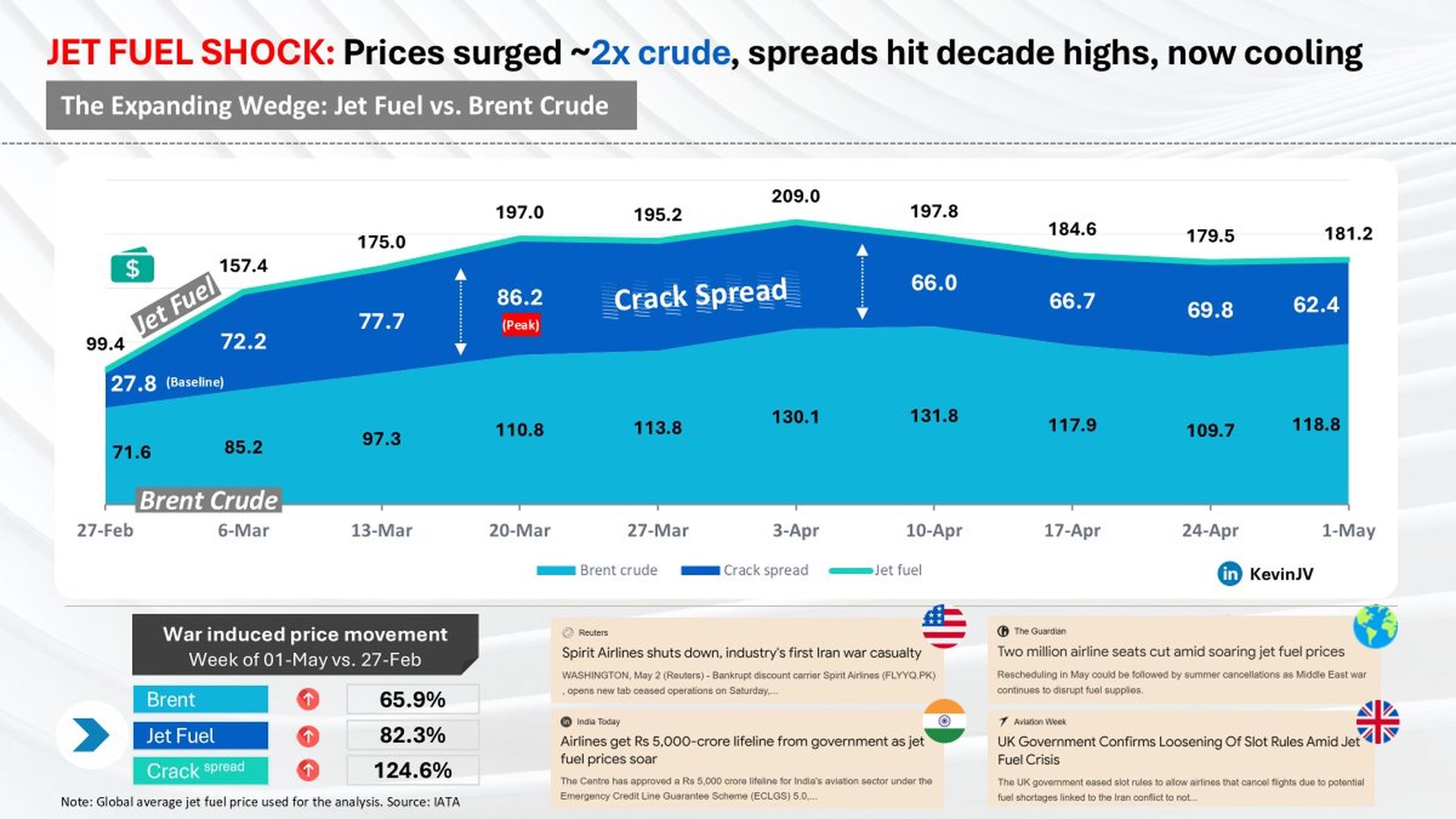
13,000 flights and 2 million seats cut in May alone. Cirium puts the June-September global seat reduction at 9.3 million. Qatar Airways has pulled 2 million seats from its summer schedule. Lufthansa has cut 20,000 short-haul flights.
Governments are beginning to act:
India's Union Cabinet approved ECLGS 5.0 - a ₹5,000 crore sovereign-backed emergency credit line for airlines, structured at up to ₹1,500 crore per borrower. The Federation of Indian Airlines had warned of airlines being "on the verge of stopping operations." The UK has suspended use-it-or-lose-it slot rules to give carriers breathing room.
The price signal is cooling:
But the structural damage is not. Jet fuel has eased from its $209 peak to $181 as of 1 May. Crack spreads have compressed from $86 to $62. Forward assessments remain sobering: even after peace is restored and the Strait reopens, fuel prices could take a year to normalise.
The numbers I shared last week have not changed. IATA's base case assumed Brent at $62, jet fuel at $88, and a crack spread of $26/bbl. At peak, we hit $131, $209, and $86, respectively. Every IATA assumption has been breached.
And it is landing on an industry that was already fragile before the first shot was fired:
>3.9% net margin operating below the cost of capital (6.8% ROIC vs 8.2% WACC). Value destruction was the starting point.
>Fleet age at 15.1 years, efficiency gains stalling as delivery delays keep older metal in service.
>Lease rates at record highs. Supply tightness is expected to persist into the next decade.
>With roughly half the cost base fixed, every dollar of fuel volatility transmits directly into margins with limited ability to offset.
The revenue side offers no cushion either. GDP is contracting across the Gulf (Qatar -8.6%, Kuwait -0.6%, Bahrain -0.5% per the IMF WEO). The Middle East was IATA's most profitable region at 9.3% net margin. It is now the one with the most to lose.
Spirit is the first domino. It will not be the last unless fuel prices correct materially and fast, or governments step in with the scale of support that the situation actually demands.
The case for intervention was strong last week. It is stronger now.
For a longer-term perspective on how fuel cycles translate into airline profitability and value creation (2015-2025): refer to the article in the comments.
(This write-up is for educational/informational purposes only; happy to amend inaccuracies, if any. Views are personal.)
First published on LinkedIn, see the original.All writing →