DIPIP Part 1: unlocking airport capacity by rethinking domestic–international segregation
DIPIP Series | Part 1 - Unlocking Airport Capacity by Rethinking Domestic - International Segregation
Airports around the world were designed around a simple assumption:
Domestic and international passengers must be physically separated.
That assumption made sense decades ago.
Today, it is increasingly inefficient with significant CapEx and OpEx implications.
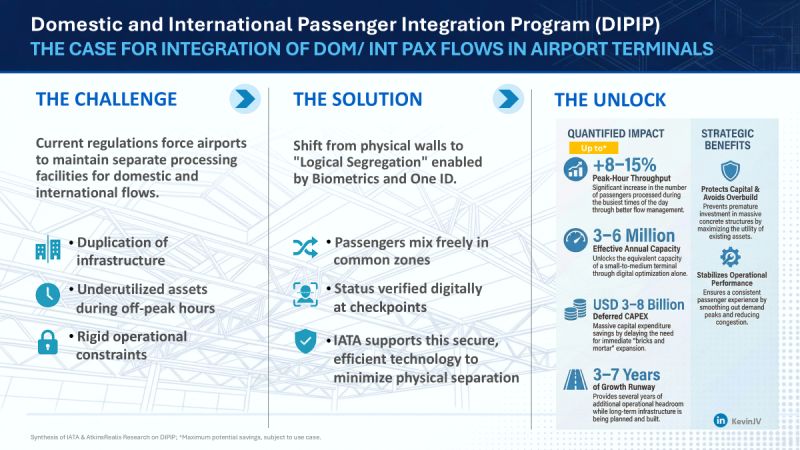
IATA’s Domestic & International Passenger Integration Program (DIPIP) challenges this legacy design principle. Instead of physical segregation, DIPIP proposes logical segregation enabled by:
• Biometrics
• One ID frameworks
• Digital status validation at checkpoints.
The result?
>Shared infrastructure.
>Higher peak-hour throughput.
>Deferred capital expenditure.
Studies indicate integration can unlock:
• Up to 15% peak throughput gains
• Millions of equivalent annual passengers
• Billions in deferred CapEx
• Several years of growth runway without concrete expansion
This is not about reducing security.
It is about modernising how security is enforced, shifting verification from spatial barriers to digital identity.
In an era where terminal expansion is increasingly expensive and timelines stretch across multiple years, capacity unlocked through optimisation may be the most immediate runway available.
From a financial and sustainability perspective, the real question is:
Can we operate smarter within the terminals we already have? (without diluting the LoS).
But transformation at this level requires alignment.
Regulators, airports, airlines, border agencies, security authorities and technology providers must move together. Logical segregation is not purely an infrastructure decision; it is a policy and governance evolution.
This is the first in a series on DIPIP, a topic close to me.
Next week: a real-world illustration using CPIR (Combined Passenger Impact Ratio) to quantify spare headroom created through asynchronous peak integration.
(This write-up is for educational/informational purposes only; happy to amend inaccuracies, if any. Views are personal.)
#Aviation
#Airports
#DIPIP
#IATA
#AirportStrategy
#PassengerExperience
#Infrastructure
First published on LinkedIn, see the original.All writing →