Decoding the Flynas IPO (live now): Network Strategy
Flynas operates a well-segmented network, focused on 5 clusters:
>Domestic
>GCC trunk routes
>VFR and Labour Markets
>Religious Corridors
>Blue-Ocean Markets
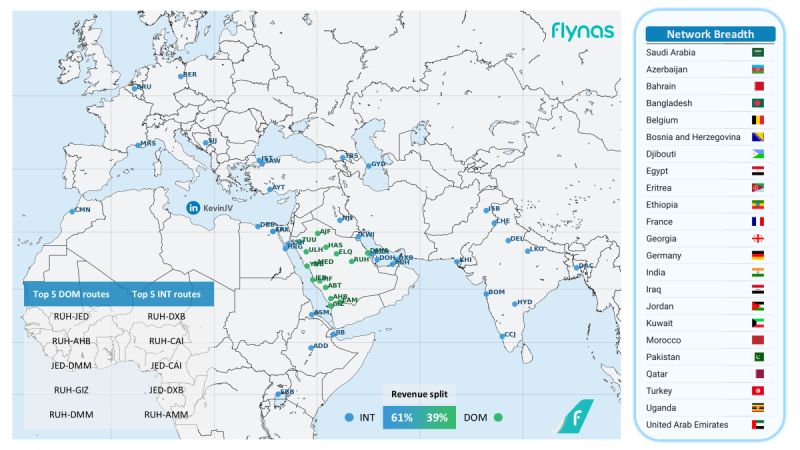
🌍 Network by the numbers (as of Sep 2024)
132 daily international flights | 106 routes | 56 destinations
134 daily domestic flights | 33 routes | 16 Saudi cities
Average stage length: 1,941 km
Revenue split: 61% INT, 39% DOM
Network Logic:
KSA:
Trunk routes like RUH–JED and RUH–DMM form the operational backbone. 100+ daily flights ensure scale, rotation, and schedule relevance.
GCC:
Flynas dominates key corridors
Riyadh–Dubai: #1 LCC (28%)
Jeddah–Dubai: #1 LCC (17%)
Riyadh–Cairo: #1 LCC (27%)
Jeddah–Cairo: #1 LCC (14%)
North Africa & Levant:
Multi-point coverage in Egypt (CAI, HBE, SSH, SPX) and direct access to Amman support both VFR and religious demand.
South Asia:
Diaspora and labour-market demand drive the network. Expansion is opportunity-rich but yield-sensitive.
Blue-Ocean Europe/Caucasus:
First-mover plays with strong results:
Georgia: +240% traffic (Yr 1 stimulation)
Azerbaijan: +360%
80% of new markets turned profitable in a year
East & Horn of Africa:
Emerging VFR and regional flows to Djibouti, Ethiopia, Uganda, and Eritrea
🌐 Pivot to Europe
There is a growing pivot westward with routes to Marseille, Brussels, and Berlin already in place. These are leisure and Umrah-aligned, and carefully capacity-matched.
I had the opportunity to work on the development of this European expansion and strategy, and it’s exciting to see the vision take flight (Induction of 321s would be key).
Geographic Growth Priorities
1. Domestic, GCC & MENA
>Deepen market presence and frequencies
> Prioritise high-yield, high-frequency routes
2. Europe, Central Asia & Africa
>Expand reach and build early presence
>Leverage first-mover advantages in leisure corridors
>Target long-range expansion with the A321neo
3. South Asia
>Selective growth to maximise utilisation
>Focused on profitability
4. Southeast Asia & West Africa (WB Strategy)
>Focus on high-density religious markets beyond NB range
Network Planning Principles
Utilisation-first: Maximise utilisation, minimise turnaround
Depth + Breadth: 2x/day on major domestic; daily on international
Seasonal agility: Align capacity with Umrah, Hajj, Eid and school holidays
Integrated Ops: Crew, maintenance, and OTP in tight sync
P2P focus: With organic growth in well-timed transit
Shared growth: Codeshare/interline to expand reach
(This write-up is for educational/informational purposes only; happy to amend inaccuracies, if any. Views are personal.)
#Flynas #IPO
First published on LinkedIn, see the original.All writing →