Aeropolitics should serve public welfare: closing the GCC–India bilaterals series
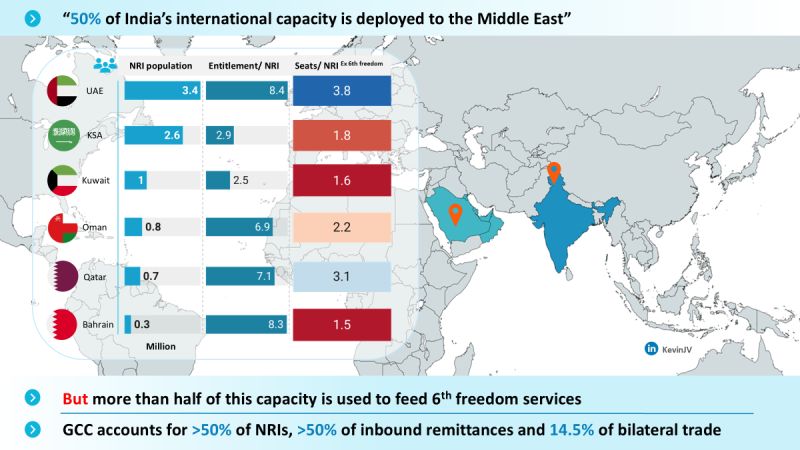
Aeropolitics should be driven by the principle of public welfare, ensuring aviation serves as a unifying force. But is it?
I wish to pay tribute to the millions of hardworking Indians in the Gulf who struggle to return home due to restrictive bilaterals and insufficient connectivity as we conclude the series "GCC-India Bilateral Air Service Agreements: A Case for Equitable Revision." They deserve better and it's high time some BASAs are renewed equitably.
Grateful to everyone who has supported this cause, both publicly and behind the scenes - including industry colleagues, parliamentarians, and diplomats. Let more doors be knocked, and voices be heard.
Link to the full series:
Edition 1 - Size and significance of the diaspora - https://bit.ly/4dkRSmz
Edition 2 - The quantum and significance of remittances - https://bit.ly/4gNwzwO
Edition 3 - The quantum and significance of trade - https://bit.ly/4dQavyW
Edition 4 - The glaring variance "Review week" - https://bit.ly/3YK2jMg
Edition 5 - Deep dive (1/2)
Exhibit 1 - A snapshot of the shift in India's international air traffic dynamics - https://bit.ly/4fLE0U0
Edition 6 - Unlocking the Massive Potential of India - Saudi Arabia 🇸🇦 Air Traffic - https://bit.ly/4fka4xG
Exhibit 2 - How the scales have tipped - https://bit.ly/3D3IFlW
(This write-up is for educational/informational purposes only and figures are directional/indicative due to strategic reasons. Refer to previous posts for more insights on the methodology used)
(Views my own; happy to amend inaccuracies, if any)
First published on LinkedIn, see the original.All writing →