Saudia’s six decades as a monopoly, and the carriers that ended it
As Saudi Arabia opens up to the world, aviation is firmly in the spotlight as one of the most powerful enablers of Vision 2030.
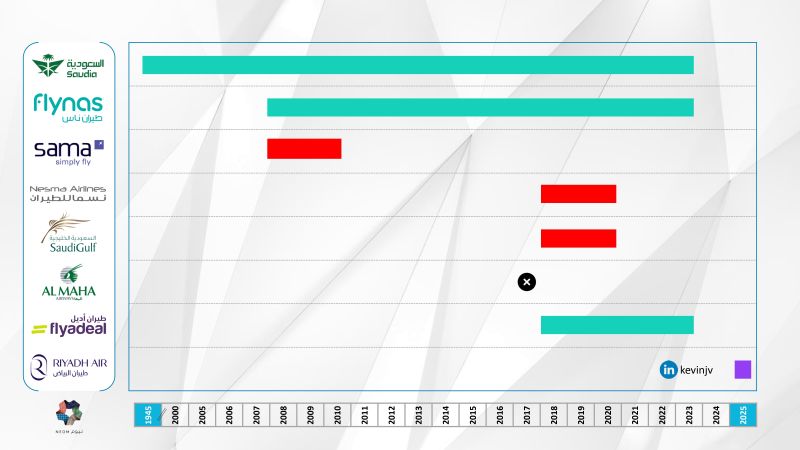
While the genesis of commercial aviation in the Kingdom dates back to 1945 (Part 1 of this series), Saudia ruled the skies till 2007 (as a monopoly) until Flynas and Sama entered the fray after 6 long decades. More on that in this edition of “Aviation in Saudi: Past, Present, and Future."
We saw how GACA transitioned to a purely regulatory role from being both a regulator and operator of airports in the last post.
A similar conflict of interest was present in the airline space too as Saudia was under the umbrella of the CAA (the predecessor of GACA - Civil Aviation Authority). Saudia eventually branched out and the CAA came to be known as the Directorate of Civil Aviation (DCA) and subsequently got rechristened as the Presidency of Civil Aviation (PCA).
In 2006, PCA was transformed into a public authority and took on the name GACA; the authority was vested with more powers and autonomy. Liberalization followed.
Flynas (Nas Air at the time) and Sama Airlines (both LCCs) were granted air carrier licenses in 2006/7, with Flynas ops based in Riyadh and Sama at Dammam.
Teething issues at the time included domestic fare caps, route dispersal guidelines, and a two-year wait period to operate international flights. High oil prices and alleged fuel subsidies to Saudia topped it and made operations commercially untenable. SAMA succumbed to losses and funding troubles in 2010.
In 2011, GACA was separated from the Ministry of Defense and Aviation (MoDA) to give it more autonomy. A royal decree in 2016 subsequently attached GACA to the Ministry of Transport (MoT) and mandated the regulator to stay at an equal distance from all operators.
This marked the second wave of liberalization. After a decade of dormancy since 2007, Saudi Gulf and Nesma emerged as two of the three carriers attempting to enter the Saudi Arabian market. Qatar's Al Maha, despite years of efforts, failed to obtain an Air Operator Certificate (AOC) and had to withdraw.
Saudi Gulf positioned itself as a premium carrier based in DMM, while Nesma (Saudi Arabia) targeted a niche with regional flights operated using ATRs. Both carriers have been dormant since the onset of the pandemic.
Saudia's low-cost arm, Flyadeal commenced operations in 2017 with its main base in JED.
On the horizon:
Saudi Arabia's second flag carrier - Riyadh Air is slated to make its debut in 2024/5
A new low-cost carrier at DMM - GACA is said to announce the license winner soon (Jazeera and Wizz openly stated plans)
NEOM Airlines - Timelines are unclear. Notably, the former CEO recently joined Air India as COO.
(Views my own; happy to amend inaccuracies, if any)
#vision2030 #saudiaviationstrategy
First published on LinkedIn, see the original.All writing →