Who Pays. How Much. When. India’s Airport Tariff Model Is Evolving.
Three recent AERA decisions at Delhi, Bengaluru and Hyderabad point to three distinct shifts in tariff design: Incidence - who pays; segmentation - how much they pay; and timing - when recovery happens.
The first two are interesting. The third is potentially much more consequential.
1. Incidence is broadening.
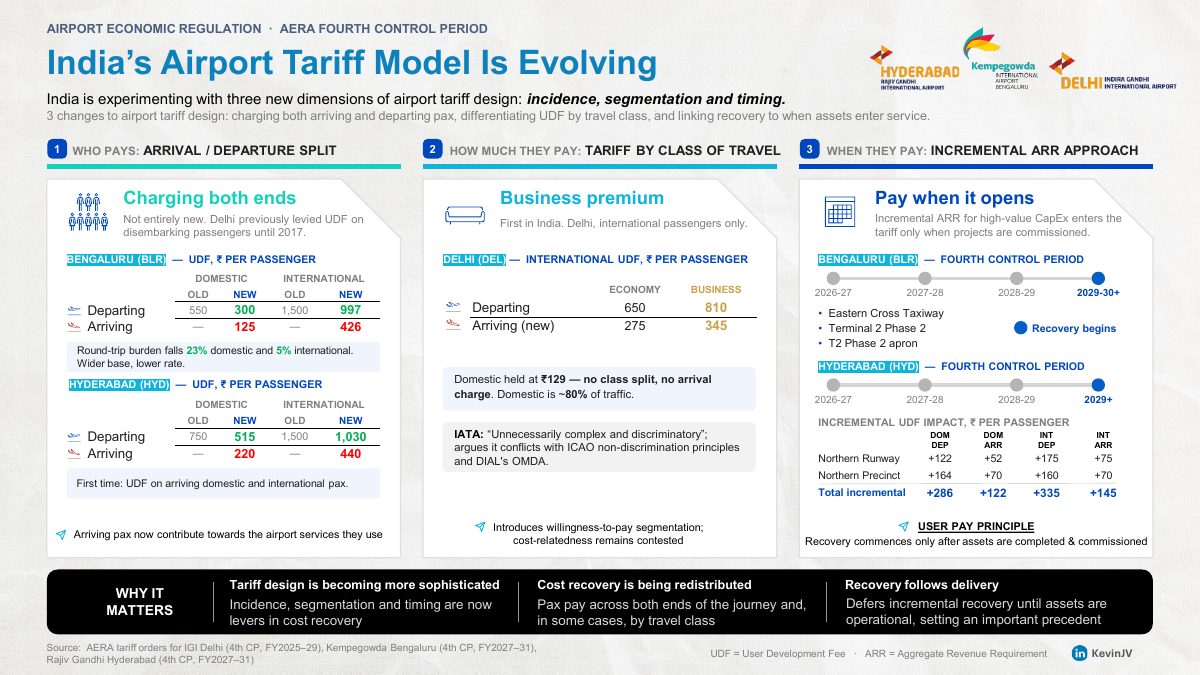
Bengaluru and Hyderabad are bringing arriving passengers into the UDF base.
The principle is straightforward: the airport is used at both ends of the journey, so cost recovery need not sit entirely with the departing passenger.
2. Willingness-to-pay is entering airport pricing.
Delhi’s differentiation of international UDF between economy and business class is perhaps the more interesting economic experiment.
A business-class passenger consumes no more runway, terminal area or screening capacity. The differential is therefore not cost causation; it is willingness-to-pay segmentation.
That may be efficient in economic terms, but remains unresolved in regulatory ones. IATA challenged the approach during consultation as discriminatory under ICAO principles and in relation to DIAL’s OMDA.
That raises a fundamental question: should airport charges recover cost, reflect willingness to pay, or do both?
3. The most consequential change may be the timing of recovery.
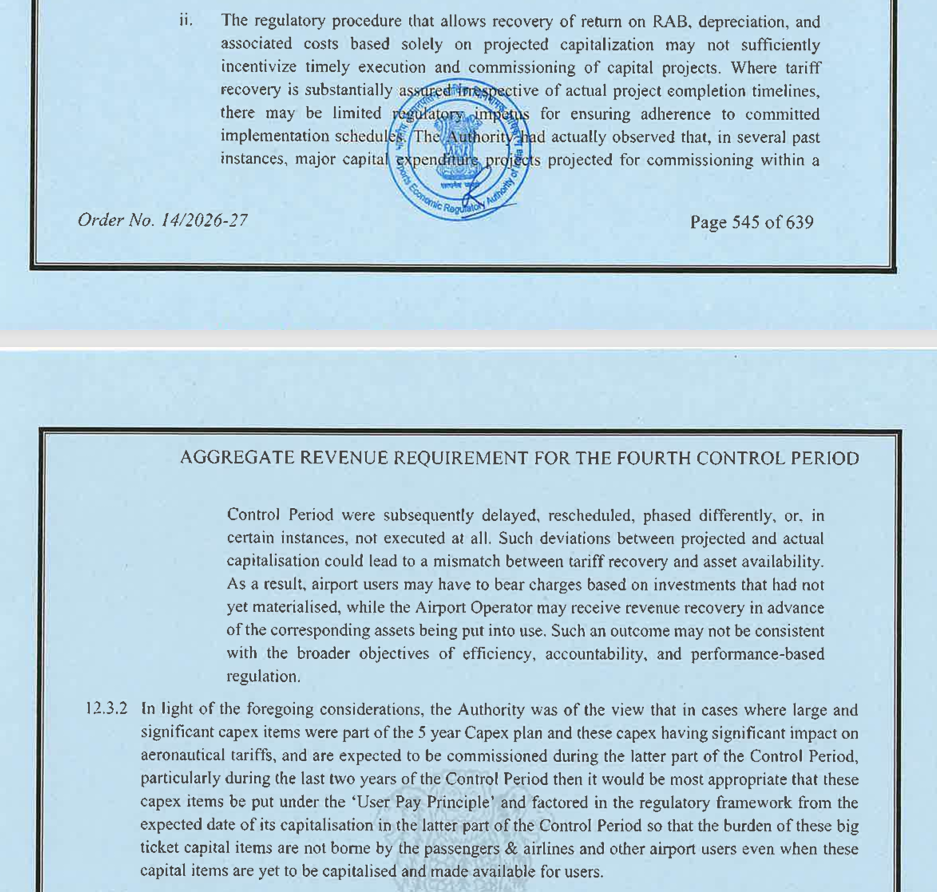
Bengaluru's Fourth Control Period introduces an Incremental ARR approach for identified high-value capex. Recovery for projects such as the Eastern Cross Taxiway and Terminal 2 Phase 2 enters the tariff when each asset is capitalised and put to operational use, rather than forming part of the base tariff from the outset.
The same underlying logic applies at Hyderabad, with incremental UDF associated with the Northern Runway and Northern Precinct entering from 2029 following commissioning.
AERA’s rationale is interesting and, in the context of India, I think a step in the right direction:
→ Align recovery with actual availability of infrastructure.
→ Protect users from paying prematurely for assets not yet available.
→ Strengthen incentives for timely project execution and commissioning.
→ Reduce the risk of over-recovery from delays, deferments or non-execution.
→ Preserve the operator’s right to recover incurred investment and earn a reasonable return once the asset is in service.
The innovation isn't the elimination of true-up. It is moving the protection from an ex-post correction to an ex-ante linkage between project delivery and tariff recovery.
For regulators building or refining airport economic frameworks, this third lever is the one worth studying.
It creates a closer alignment between capital deployment, project delivery, asset availability and tariff recovery, without denying the operator returns.
(This write-up is for educational/informational purposes only. Views are my own; happy to amend inaccuracies, if any)
#airportariff #india
First published on LinkedIn, see the original.All writing →