Why aren't aviation leaders more unsettled by these numbers
Why aren't aviation leaders more unsettled by these numbers? And why aren't investors more selective about where their capital goes?
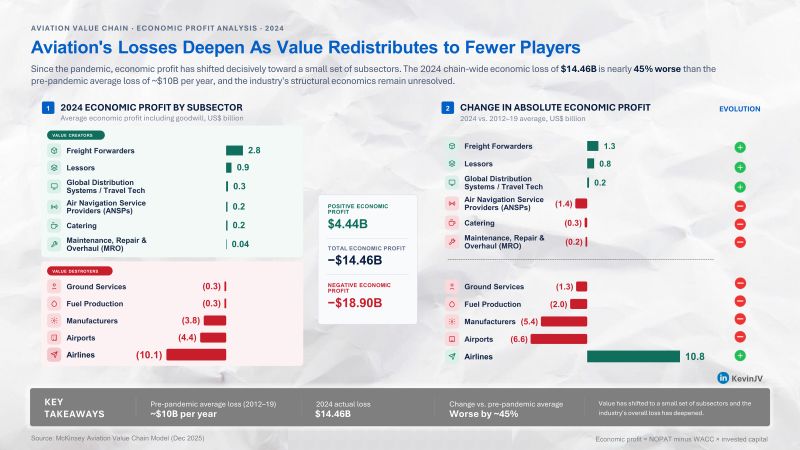
McKinsey's latest aviation value chain analysis puts a number on how far this industry still is from solving its core economic problem. The aggregate economic loss deepened to $14.46B in 2024, worse than the ~$10B average annual loss recorded from 2012 to 2019. This happened despite airlines, historically the weakest link in the chain, posting a $10.8B improvement versus their pre-pandemic average, the single largest turnaround of any subsector tracked.
That's the paradox worth sitting with: the biggest recovery story in the value chain still wasn't enough to offset losses elsewhere.
Two subsectors moved sharply the other way. Airports recovered traffic to pre-pandemic levels but not profitability. Capital intensity and rising costs, particularly in Asia-Pacific, outpaced returns (–$6.6B vs. 2012–19). OEMs extended a multi-year stretch of value destruction (–$5.4B).
But the sharpest finding still sits with airlines. Even after that $10B+ improvement, industry-wide ROIC remained below WACC in 2024, a gap McKinsey's model traces back to at least 1996.
The conclusion isn't that aviation is broken.
Every subsector contains genuine value creators. Around 36% of airlines in McKinsey's sample generated returns above their cost of capital. Lessors, freight forwarders and travel technology providers remained among the strongest performers across the value chain. Even airports tell a more nuanced story: Europe and several other regions generated economic profit, while Asia-Pacific and North America weighed heavily on the aggregate result.
Demand isn't the constraint; passenger traffic is above pre-pandemic levels and load factors are at record highs. Increasingly, the defining question is whether that demand translates into economic value after accounting for the capital required to serve it.
For leadership teams, the priority should be to make disciplined capital allocation decisions, matching capacity expansion with sustainable returns, optimising cost structures and understanding where value is actually created within the ecosystem, not simply where revenue or traffic is growing.
For investors, the message is equally clear. This analysis is not an argument against investing in aviation. It is an argument for discrimination within it. The companies consistently earning returns above their cost of capital exist alongside those that continue to destroy value. Treating the sector as a homogeneous investment opportunity risks missing the distinction that ultimately matters most. Capital deployed without that distinction is capital deployed blind.
(This write-up is for educational/informational purposes only; happy to amend inaccuracies, if any. Views are personal.)
First published on LinkedIn, see the original.All writing →