KSA fleet | The numbers point somewhere the headlines don't.
Riyadh Air commands the attention, and rightly so. Every aircraft delivery and every route announcement attracts global coverage. It is arguably the most anticipated airline launch in a generation.
But if you're only watching Riyadh Air, you're missing the carrier making the biggest capacity commitment in Saudi Arabia's aviation growth.
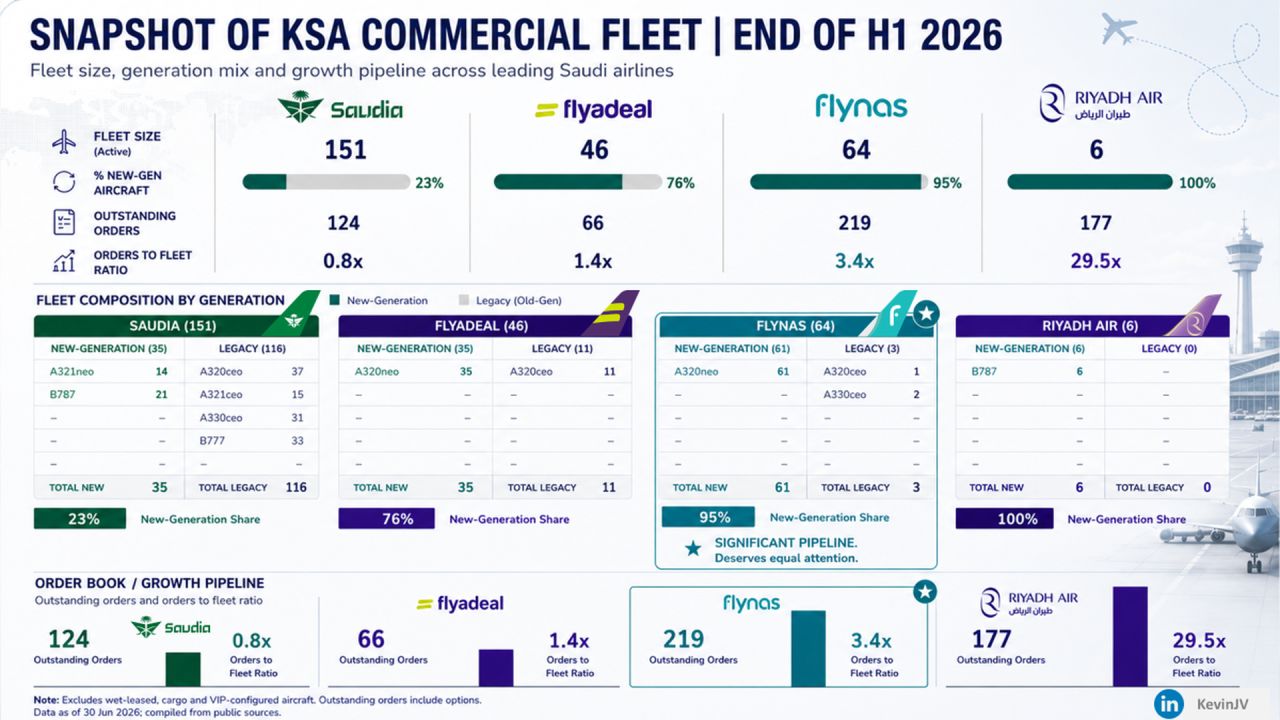
flynas has 3.4 outstanding orders for every aircraft in its fleet today.
That's the highest ratio of any established Saudi carrier, well ahead of flyadeal (1.4×) and more than four times Saudia's (0.8×). Excluding Riyadh Air, whose 29.5× ratio reflects the build-out of an entirely new airline from a very small base, flynas is by far the Kingdom's most aggressive growth story.
In fact, Saudi Arabia's largest commercial aircraft commitment today belongs neither to the Kingdom's newest flag carrier nor to its national carrier, but to its largest private airline.
A few observations stood out while putting this analysis together:
1. Saudia's order book is smaller than it appears.
At first glance, 124 outstanding aircraft appears substantial. However, a significant portion of the existing fleet comprises previous-generation aircraft - A320ceo, A321ceo, A330ceo and an ageing B777 fleet that will need replacing over the coming decade.
Viewed through that lens, much of Saudia's order book is likely replacement rather than expansion. Unless additional aircraft are secured, net capacity growth could be considerably lower than the headline number suggests.
That said, the airline is reportedly in negotiations for an additional 150 aircraft, potentially the largest order in its history, which, if concluded, would reshape its growth trajectory.
2. Fleet quality is becoming a structural competitive advantage.
Today, flynas already operates one of the Kingdom's youngest fleets, with approximately 95% new-gen aircraft in the mix. Combined with its order book, this creates long-term structural advantages in fuel efficiency, maintenance costs, operational reliability and ultimately unit costs.
Over time, it could become one of the most durable competitive advantages in aviation.
3. The order book is only the beginning.
Collectively, Saudi Arabia's airlines now have 586 aircraft on order.
Aircraft deliveries, workforce development, maintenance capability and airport infrastructure must all scale in parallel if these ambitions are to materialise.
The next decade will be defined not simply by how many aircraft enter the Kingdom, but by how effectively the entire aviation ecosystem evolves around them.
(This write-up is for educational/ informational purposes only, and figures are directional at best)
(Views my own; happy to amend inaccuracies, if any)
#SaudiArabia #Aviation #Saudia #flynas #flyadeal #RiyadhAir #Vision2030 #NationalAviationProgram #Fleet #Airlines
First published on LinkedIn, see the original.All writing →