An injustice corrected: India–Kuwait bilaterals get their first revision in two decades
An Injustice Corrected: India-Kuwait Bilaterals Get First Revision in Two Decades
Those who have followed my work know this is a subject I have been very vocal about - India’s approach to negotiating bilateral air service agreements with GCC countries. I have long argued for a nuanced, diaspora‐first approach that corrects past allocation missteps through realistic, fair negotiations, rather than compounding disparities with unequal entitlements.
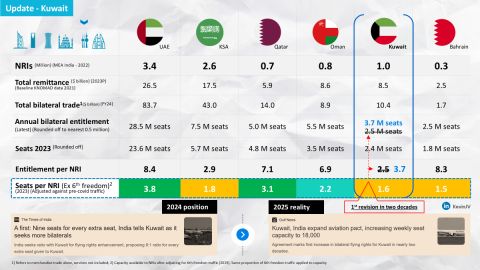
In a positive turn, India and Kuwait have revised their BASA after nearly 20 years, increasing seat entitlements from ~2.5M to 3.7M annually (about 18,000 weekly seats).
Context:
>Kuwait’s Indian diaspora now exceeds 1 million - over 3× its size at the time of the last revision in 2007.
>Yet, Kuwait has been one of the most underserved GCC markets, with just 1.6 seats per NRI (adjusted for 6th freedom) in 2023 - the lowest among GCC countries.
>The new entitlement narrows the gap, but Kuwait - home to the third‐largest GCC Indian diaspora after the UAE and Saudi Arabia still ranks second‐last in entitlements per NRI.
Why this matters:
1. Kuwait is a predominantly point‐to‐point market with limited 6th freedom leakage - meaning a large majority of extra capacity directly benefits NRIs rather than connecting traffic flows. (Kuwaiti carriers are not significant players in the 6th freedom market compared to some of the neighbours, so the reluctance to revise the bilaterals equitably was baffling and unreasonable)
2. The increase creates headroom for more direct, affordable travel options for the diaspora, especially during peaks when fares have historically spiked due to demand outstripping supply.
3. It signals a willingness to revisit outdated bilaterals that no longer reflect present‐day needs.
A note on the negotiations:
In early 2024, the Indian side proposed a 9:1 ratio in its favour, nine additional seats for India for every incremental seat to Kuwait (apparently highlighting the disparity in points of call).
It was a ridiculous, self‐defeating ask. Gladly, sense prevailed, and a fairer, mutually beneficial agreement was reached, undoing a long‐standing imbalance. Kudos to officials on both sides!
Bottom line:
While this revision is a welcome course correction, the real test will be whether India applies the same pragmatic, data‐driven, diaspora‐first lens to future GCC bilaterals, aligning entitlements with actual P2P demand rather than legacy allocations - where some agreements appeared more attuned to 6th freedom needs.
(This write-up is for educational/informational purposes only; happy to amend inaccuracies, if any. Views are personal.)
This is an update of a previous post - for the full series, more context, check the link in the comments.
First published on LinkedIn, see the original.All writing →