When Fleet Planning Goes for a Toss
⚠️🛫 When Fleet Planning Goes for a Toss: How Boeing’s Delivery Delays Undermine Airline Strategy (Best viewed on📲)
Fleet planning is more than just ordering aircraft - it's a critical pillar of an airline’s long-term success. It determines network expansion, cost efficiency, competitiveness, and sustainability. When deliveries fall behind schedule, it has ripple effects on profitability, growth, and operational resilience.
For the last few years, Boeing’s widebody production challenges have thrown airlines’ fleet renewal plans into disarray, forcing them to adapt fleet phasing strategies at significant cost.
📉 Crisis in Numbers
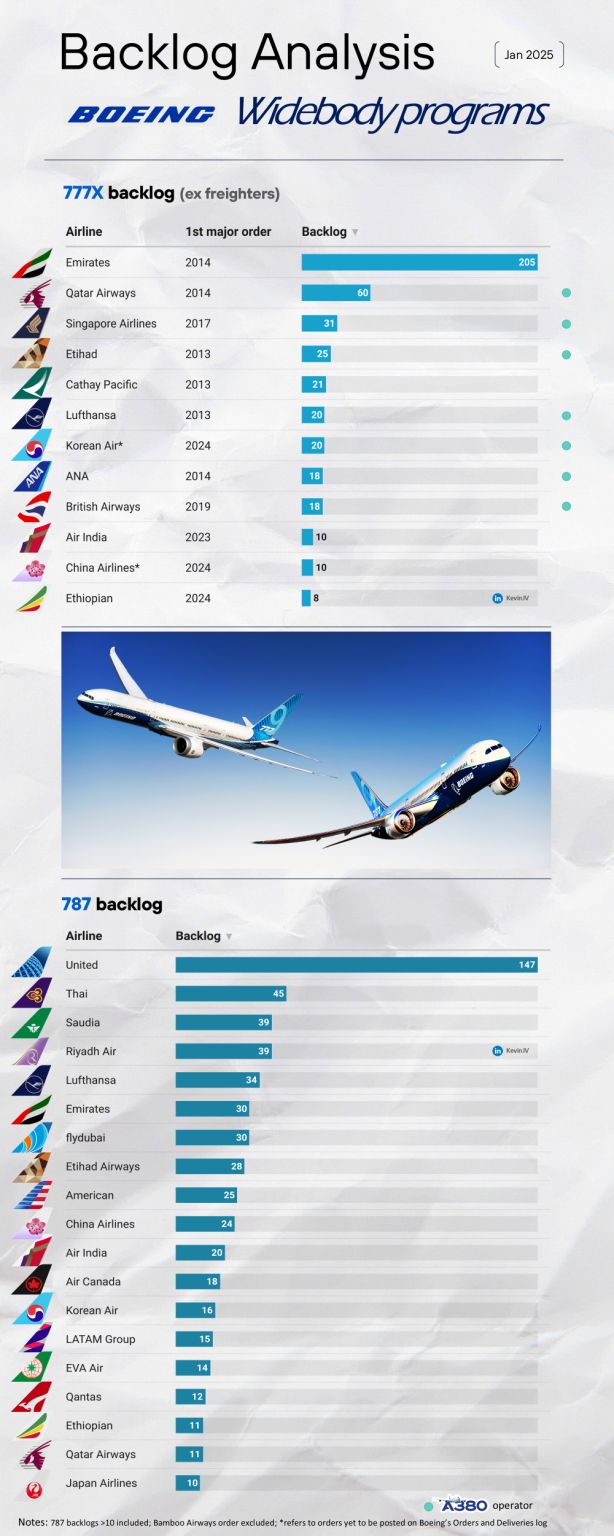
777X backlog: 446 aircraft
🔹777X program launched in 2013 → Initial delivery timeline set for 2020 → As of Feb 2025 FAA certifications are still underway.
🔹First deliveries are now expected in 2026 (6-7 years behind schedule), but airlines remain skeptical given Boeing’s recent track record.
🔹Commercial production has yet to begin, with output expected to start in 2026 at 2-3 per month, ramping up to 5 per month eventually.
🔹At 3 per month, clearing the 446 aircraft backlog would take ~12.5 years.
🔹Even at 5 per month, it would still take 7.5 years to fulfill current orders.
787 backlog: 796 aircraft
🔹Production is currently at 5 per month, with plans to ramp-up to 7 in late 2025 and 10 eventually → Even at full ramp-up, clearing the existing backlog would take 6.5 years.
Production Hurdles Persist:
🔹Seat certifications and heat exchanger issues continue to delay deliveries.
🔹$1 billion CAPEX at Boeing’s South Carolina facility aims to increase 787 output, but execution risks remain.
When aircraft deliveries stall, airlines are forced to delay fleet retirements, extend aircraft leases, and rely on suboptimal fleet compositions, increasing operating costs and reducing competitiveness.
Airlines cannot phase in new aircraft as planned without a stable production roadmap.
🌍 The Consequences of Fleet Phasing Disruptions:
1️⃣ Route Expansion Bottlenecks → Airlines are unable to execute planned network growth, leading to missed revenue opportunities.
2️⃣ Aging Fleet & Cost Escalation → The global fleet age now averages 14.8 years, the highest since 1990, resulting in:
>Higher fuel consumption
>Increased maintenance costs
>More frequent aircraft downtime
3️⃣ Sustainability & Efficiency Targets at Risk
4️⃣ Leasing Dependence Rises → Soaring costs and margin pressures
💡 Connect the dots to figure out where to invest!
🔥 For more context - Capacity Crunch: A 13+ Year Backlog + How aircraft demand for GROWTH v/s REPLACEMENT has tipped.
Read the full piece: https://bit.ly/411kblA
If you found this insightful, please like/ repost! ♻️
(This write-up is for educational/informational purposes only; happy to amend inaccuracies, if any)
#AircraftDeliveries #FleetPlanning #Airlines
First published on LinkedIn, see the original.All writing →